

The Law Society recently published a report into the use of Agentic AI in Legal Practice and how it may shape the future of the profession.
As always at JBL, we read this and instantly thought of the compliance angle. What does the use of such new and innovative AI models mean for the profession? And, arguably, more importantly, how can we ensure that firms and solicitors remain compliant in this ever changing landscape where the regulations are struggling to keep up with innovation.
In the report it is stated that we are moving away from generative AI that simply responds to prompts and toward Agentic AI. Agentic AI are systems that set goals, plan actions, and execute strategies with minimal human instruction.
The rather ingenious explanation the report uses for the difference in AI is to think of traditional AI as a skilled musician who can play a specific part when told. Compared to Agentic AI which is the conductor, reading the score, sequencing the contributions of others, and adjusting as the performance evolves.
While the promise is one of unprecedented efficiency, the transition raises uncomfortable questions about supervision, the hollowing out of junior talent, and the structural limits of the Legal Services Act (LSA).
Managing the Digital Army – how do we supervise AI?
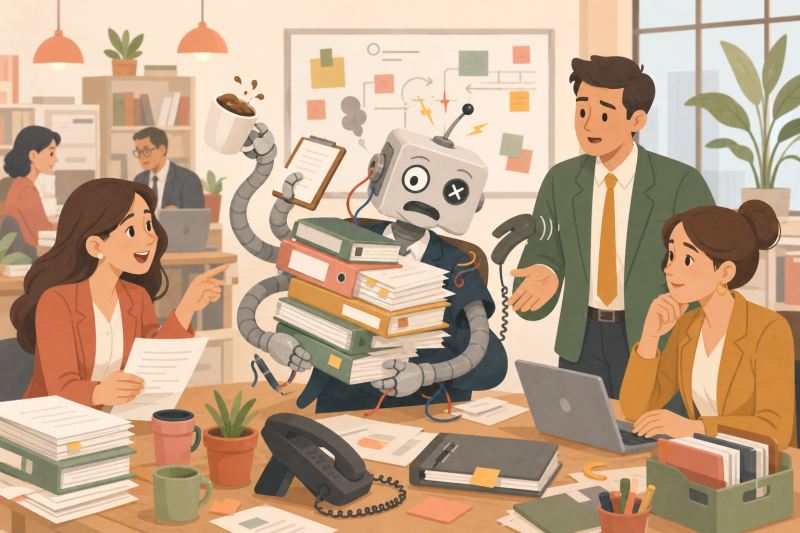
The most immediate promise of agentic AI is the ability for an individual to manage a flood of digital representatives. However, this efficiency brings with it a significant verification nightmare and begs the question….how efficient will that actually be?
Current evidence suggests that while AI can draft a 200-page witness statement in seconds, the time saved in creation is often eclipsed by the effort required for human verification. The more the machine produces, the more the human must audit.
Supervision is a hot topic. We see this in our day to day. Supervision of work is not overly glamorous and it is often seen as an absolute pain in some firms. If firms find it difficult to ensure supervision of its humans, how will it cope with the output of added AI workers?
The report suggests that agentic AI may move from doing the law to a coordinating layer for workflows. Therefore shifting the lawyer’s role from a craftsperson, drafting documents, arguments and building case files from the ground up to an administrator, reviewing AI generated work ultimately checking and signing off the digitally crafted documentation.
Another element of the report highlighted that firms are beginning to use “statistical validation”. Simply put this is a human reviewing a random sample of AI outputs to estimate risk. How many mistakes are acceptable in the name of progress and efficiency? How can we be sure the dip sample taken shows the full extent of the work of the AI, both good or bad?
As the Mazur case recently reminded us, supervision is not a substitute for professional authorisation.
This evolution raises critical concerns about the proper use of professional expertise; solicitors did not undergo years of rigorous training simply to become “babysitters” for AI-drafted work. Substituting deep, manual skill for superficial statistical sampling risks. Are we in danger that this is undermining the very essence of the profession?
Perhaps the most concerning risk is invisible substitution. If agentic AI takes over the “easy work” typically handled by paralegals and junior solicitors. Things such as document reviews, research, and basic drafting, how will the next generation of solicitors ply their trade?
Unless a massive overhaul of practical legal training takes place, junior lawyers may lose the learning opportunities provided by routine tasks, weakening the talent of the future.
There is an argument that we may see the emergence of Agentic AI Specialists or multidisciplinary teams. With lawyers acting as translators between AI coding, output and client needs.
Can the Legal Service Act (LSA) keep up?
The UK government and regulators currently insist on a lawyer in the loop, which is also a structural requirement of the LSA.
The recent Mazur case clarified that only authorised individuals may conduct litigation, although supervised non-lawyers may take most of the practical steps in the case.
Under the logic of that ruling, an agentic AI system, no matter how sophisticated, cannot independently issue claims, file pleadings, or take strategic litigation decisions. It needs to be supervised. How do we do that? Can we see its legal reasoning? Will we trust that it is telling us everything?
If we are not careful, we are heading toward a compliance hole. A situation where accountability is misattributed to a human solicitor who had very little sincere agency over a system’s behaviour.
If an autonomous agent finds a winning legal strategy, such as prolonging litigation to maximise its primary goal of “winning”, and it does so without human sign-off, it is the lawyer in control of that case who bears the risk.
Lawyers could end up being held responsible for outputs they cannot meaningfully audit or comprehend. This would set up the profession for potential failure unless liability models evolve – potentially toward shared responsibility between developers and firms.
By 2040, the Law Society report suggests the profession may fracture into two distinct identities. Human-First firms, emphasising judgment and ethics, and AI-Optimised firms, where efficiency and analytical insight define the firm.
In my view, the enduring value of the lawyer will rest in what AI cannot replicate. Empathy, human interaction and navigating changing and complex relationships.
Clients may go to ChatGPT (other AI platforms are available) for a legal answer, but they will still go to a solicitor to solve a problem. A problem which often involves commercial and emotional factors that extend beyond pure legal analysis or cold hard data.
Full agentic AI adoption is currently non-existent in UK law firms; we are mostly seeing supervised generative AI in structured workflows.
Of course, .professional indemnity insurance remains a major consideration. Unless insurers are happy to sign off on unsupervised AI (unlikely), then “lawyer in the loop” remains a necessity for survival and of course a requirement of regulation and the LSA.
However, Agentic AI is not just another tool; it is a potential new player in the legal ecosystem. Firms will find themselves under pressure to push the boundaries of what is technically possible.
The question for the next decade is whether the legal profession will shape this conductor’s baton or simply follow the music it creates.


